It has been an interesting year so far. Back in March I checked on the bees again and the hive was down to a very small cluster. So small in fact I gave them up for dead. It looked like the queen had just stopped laying for some reason. Then we found out short sale house we had a contract on finally came through after 9 months and in 3 weeks we had to close or loose it. Between moving and then doing work on the house that needed to be done quickly the bees got lost in the shuffle. Two weekends ago my wife and I finally got back out to the mountain to check on them. I was planning on cleaning out the hive hoping that the wax moths hadn't found the hive yet. As we walked toward the bee yard I see bees coming out of the hive, not a lot, but bees. Naturally I had to pop the top and see what was going on. Well what do you know, bees! And lots of them! And two boxes full of honey! I guess the queen must have started laying again right after I checked them in March. The good news is they lived. The bad news is that I probably could have gotten honey this year. Oh well, there wouldn't have been any time to extract it anyway. We have decided to let nature take its course with this hive and will do minimal intervention on it and see what happens this winter. I plan only on performing the Fumigilan treatment for Nosema, put a few empty frames in during goldenrod season to get some extra honey built up for winter, and wrapping the hive with roofing paper as I did last fall.
Monday, August 29, 2011


Sunday, January 2, 2011
Warm New Year's Day
It was in the 50s on New Years Day so after we woke up my wife and I drove out to the mountain to check the bees and do some other work. A warm winter day is a good chance for us to check on the level of honey left, add some bee candy if necessary and move the frames around to get stored honey closer to the cluster. It is a good chance for the bees to take a cleansing flight, clean the dead bees out of the hive, and move honey stores around to get closer to the cluster.
Since December had been such a cold and windy month I was worried they may have gone through the stored honey quickly and since I felt the hives were light going into winter I was anxious to see how they were doing. Unfortunately we met with some bad news. The GA bees had died out. I did a quick look through the frames in the top and middle hive bodies and am stumped as to why. There was plenty of honey. There was plenty of pollen. You could see the cluster of bees was still fairly big and they were right next to the honey so they shouldn't have starved. I didn't see any sign of disease. A deadout like this is so weird because the bees don't shrivel up or anything, they look like they are just being very still and they would fly away at any second.
The good news is that the other hive is doing well. I pulled the top box frames and they were still full of honey and pollen. I didn't take the box off but I could see the cluster in the middle box and it appears to be a good number of bees. It looks like they made it through that cold December pretty well. Our long range forecast is for a fairly normal January, maybe a little below normal temps so I am optimistic that if they survived the really cold December they will be OK.
Since December had been such a cold and windy month I was worried they may have gone through the stored honey quickly and since I felt the hives were light going into winter I was anxious to see how they were doing. Unfortunately we met with some bad news. The GA bees had died out. I did a quick look through the frames in the top and middle hive bodies and am stumped as to why. There was plenty of honey. There was plenty of pollen. You could see the cluster of bees was still fairly big and they were right next to the honey so they shouldn't have starved. I didn't see any sign of disease. A deadout like this is so weird because the bees don't shrivel up or anything, they look like they are just being very still and they would fly away at any second.
The good news is that the other hive is doing well. I pulled the top box frames and they were still full of honey and pollen. I didn't take the box off but I could see the cluster in the middle box and it appears to be a good number of bees. It looks like they made it through that cold December pretty well. Our long range forecast is for a fairly normal January, maybe a little below normal temps so I am optimistic that if they survived the really cold December they will be OK.
Friday, December 24, 2010
Natural Sculptures and Happy Holidays
I'm really glad I decided to wrap the hives this year. We had a nice, warm November but December has been brutal! It has been cold and windy and just plain nasty weather so I hope the wrap has given the girls a better chance of making it through the winter. The end of this week we might actually get warm enough to take a quick look and see how they are doing.
Winter certainly isn't my favorite time of year but I do like going to the mountain when it is at least 40-45 and calm. Working keeps me warm and this time of year has a beauty all its own. It may not be the most colorful time of year but to me it is beautiful because it is peaceful and silent. Sometimes nature give you a little surprise and I wanted to share the surprise from this day with you. These little ice crystals form when the conditions are just right; the ground has to be wet enough but not too wet, the temps have to be above freezing during the day but below freezing at night, there has to be ground that is clear of vegetation, and the soil has to be dense enough to force the crystals upwards. And then you have to get outside early enough to actually see the show before it melts. When all these things happen this is what you get and these pictures are my Christmas present to you, my readers. MERRY CHRISTMAS!!


Winter certainly isn't my favorite time of year but I do like going to the mountain when it is at least 40-45 and calm. Working keeps me warm and this time of year has a beauty all its own. It may not be the most colorful time of year but to me it is beautiful because it is peaceful and silent. Sometimes nature give you a little surprise and I wanted to share the surprise from this day with you. These little ice crystals form when the conditions are just right; the ground has to be wet enough but not too wet, the temps have to be above freezing during the day but below freezing at night, there has to be ground that is clear of vegetation, and the soil has to be dense enough to force the crystals upwards. And then you have to get outside early enough to actually see the show before it melts. When all these things happen this is what you get and these pictures are my Christmas present to you, my readers. MERRY CHRISTMAS!!


Wednesday, December 8, 2010
All wrapped up
The weekend after Thanksgiving I put some bee candy in the hives. I decided I was going to wrap them this year. It has been such a tough year for the poor girls I wanted to give them every chance I could to get them through the winter. But I forgot the staple gun and couldn't wrap them and tie them with twine at the same time so I had to wait for help. I probably could have if I would have thought about ratcheting the tiedowns around them, but I didn't so I was out there in the cold struggling to get the tar paper around them.
Last weekend Michele came with me and we were able to get them wrapped. It was at best 40 degrees and the GA bees were moving around and were on the candy. I figured they would be clustered. I really don't know why they weren't. The CA bees were in a nice tight cluster down deep in the hive with the faintest buzz and breath of warmth coming up. I know it was really too cold to have the hive open but I wanted to replace the hive bodies on top that I had used to cover the feeders with a smaller shim and it wasn't supposed to get warmer all week. But I had the inner cover open for only seconds so I think the trade-off was worth it. And now they are wrapped and snug with some nice candy for the winter.
Last weekend Michele came with me and we were able to get them wrapped. It was at best 40 degrees and the GA bees were moving around and were on the candy. I figured they would be clustered. I really don't know why they weren't. The CA bees were in a nice tight cluster down deep in the hive with the faintest buzz and breath of warmth coming up. I know it was really too cold to have the hive open but I wanted to replace the hive bodies on top that I had used to cover the feeders with a smaller shim and it wasn't supposed to get warmer all week. But I had the inner cover open for only seconds so I think the trade-off was worth it. And now they are wrapped and snug with some nice candy for the winter.
Monday, November 22, 2010
Peaches
With the honey we harvested this year we gave some away, sold a little, and we have cooked with some. It's really good with fish and some herbs. I found a recipe for Honey Packed Peaches on the National Honey Board web site. You can find it here. One day on the way home I stopped and got the peaches and a couple days later we whipped up half a batch. Peaches, honey, and vanilla; what's not to like! They are soooo good. But actually unless we didn't cut the recipe in half correctly there was a little too much vanilla. Next time we make them we will use a little less.
Sunday, November 21, 2010
Rush Hour
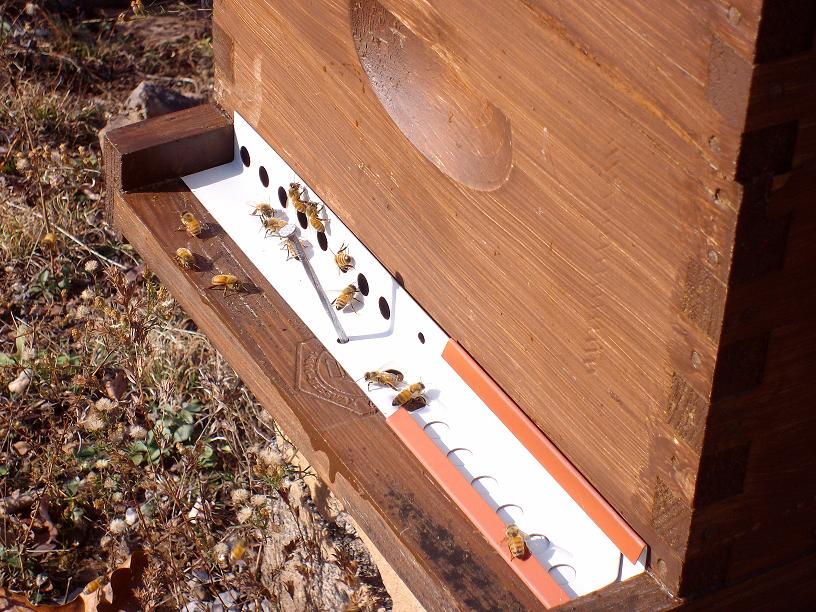

Yesterday was a beautiful day in the VA Shenandoah valley. It was bright and sunny and 60 degrees. Just after noon I went to feed the bees what I thought would be one last time since the cold weather is coming. It is the end of November after all. I figured 60 degrees I would see a few bees out for cleansing flights (aka pooping). Above on the left is the picture of the GA bees from the package I installed this spring. Not a whole lot of action going on there. On the right is the nuc I got with the Northern CA queen. Wow! Look at all the activity going on there. They were literally fighting to get in and out of the mouse guard. Bee rush hour, I suppose. Take a closer look and see if you can see the real interesting thing. Check out the girl in the picture below. Pollen?!? Where in the world are they finding pollen? Sure it was maybe 1 in 75 bees coming back with some, but still, it is November 20th!
 So I unzipped my hood and took a few steps back and tried to see where the beeline was going. I thought I got the general direction so I started walking. I eventually found 1 thistle with 3 blooms but with no bees visiting it. I also found one small aster, again with no bees. I gave up after 10-15 minutes. They could have been flying all the way across our hollow for all I know. Or I could have picked the wrong beeline. They are obviously better at finding flowers than I.
It is an interesting thing these bees. My last article was on genetics and how the CA bees seem to be all over the place genetics-wise. If anyone has read since the beginning you may remember that from the beekeeping class they recommend getting 2 hives so you can see if they are both doing the same thing or if one is definitely stronger or weaker than the other. But that is generally two hives from the same source. This year having two hives with queens from different geographical locations has been quite interesting. While they both appeared the same during the summer, once the weather has cooled the CA bees have been consuming the sugar syrup at a greater rate, putting more weight on the hive, and are much more active during the warm part of the day. I still have to see how the winter turns out but it looks a lot like the CA bees are going to make it, at least by how active they are and how many stores they have. The GA bees are not as active and have fewer stores going into winter. Certainly the GA packages were a lot cheaper than the CA nuc but if they don't survive the winter I miss the early spring nectar flow which really cuts down on the honey harvest.
Monday, November 8, 2010
Genes
 Nothing like genes to make things interesting. This picture is from the hive that started from a nuc this spring. The queen came from somewhere in northern California. Most of the summer the hive acted pretty much the same as the hive that started from the Georgia package. But while the package bees are all the "normal" 3 banded Italian golden yellow color check out these bees. There are bees the color of 3 banded Italian, one near the lower left has the black body of a Caucasian, and there are the grayish bees typical of Carniolans. All these different traits from one queen. Amazing. Hopefully this nice diversity will translate to a nice strong hive that is going to make it through the winter just fine. The last week or so it has been 50s during the day and 30s-40s at night and these girls are still more active than they GA bees. They also have put more weight on while I have been feeding them. Ain't genes great! (Click the image for a better look.)
Subscribe to:
Posts (Atom)


 Posts
Posts

